Algorithm complexity can be represented by Big O notation, for example, the following piece of code has  complexity that sums up the array.
s = 0
arr = [1, 2, 3, 4, 5]
for i in arr:
    s += i
How do we know which is better: If we have  and
and  where k is a constant. We can compute its limitation. i.e.

Therefore, is better than .
For polynomial expressions, the highest complexity is often counted as the final complexity. For example,
s = 0
arr = [1, 2, 3, 4, 5]
for i in arr:
    s += i
cnt = [2, 3, 4, 5, 7]
for i in arr:
    for j in cnt:
        s += i * j
consists of two parts: and  . Therefore, the final complexity is represented by
If 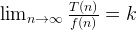 where k is a constant, therefore
  is the complexity of
  .
.
Given the above example,  , we can say, the overall complexity is .
–EOF (The Ultimate Computing & Technology Blog) —
718 wordsLast Post: Sign Area of Irregular Polygon
Next Post: Codeforces: 239A. Two Bags of Potatoes