Understanding the Sigma Function: Divisors, Multiplicativity, and the Formula
Understanding the Sigma Function: From Divisors to a Powerful Closed Formula
Why the Sigma Function Is Multiplicative: A Step-by-Step Derivation
The Mathematics Behind σ(n): Divisors, Prime Powers, and the Product Formula
A Deep Dive Into the Sum-of-Divisors Function (σ): Theory + Python Code
Decoding σ(n): The Elegant Structure of Divisors and the Geometric Series Trick
Prime Factorization Magic: How the Sigma Function Really Works
Sigma Function Explained Clearly — With Proofs and Efficient Python Code
The sigma function, often written as 


Divisibility Notation
In number theory, the symbol “|” means “divides.”


So in the expression 

Prime Factorization and Divisors
Every positive integer 



Understanding the structure of divisors begins here. A divisor of


All divisor-related properties follow from this simple but powerful fact.
The Key Insight: Sigma Is Multiplicative
The sigma function satisfies the following rule when two integers share no common prime factors:


Why does this work? Because when 


Formally:


When we sum all divisors of


We now factor the double sum. Fix a particular divisor 



Now sum over all


This proves the multiplicativity of the sigma function.
The Sigma Formula for Prime Powers
Once we know that sigma is multiplicative, we only need to calculate 



This is a geometric series, and its sum is:


Using multiplicativity gives us the general sigma formula:
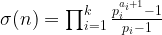

This is the closed-form expression for the sum of divisors of any positive integer.
Example: Computing σ(12)
Factorize:


Compute each part:




Multiply:


Python Code: Efficient Sigma Function
Below is a fast Python implementation that factorizes the integer and uses the multiplicative rule. This runs in approximately 

def sigma(n: int) -> int:
    """Efficient computation of the sum-of-divisors function σ(n)."""
    total = 1
    x = n

    # Factor out powers of 2
    count = 0
    while x % 2 == 0:
        x //= 2
        count += 1
    if count > 0:
        total *= (2 ** (count + 1) - 1) // (2 - 1)

    # Factor odd primes
    p = 3
    while p * p <= x:
        if x % p == 0:
            count = 0
            while x % p == 0:
                x //= p
                count += 1
            total *= (p ** (count + 1) - 1) // (p - 1)
        p += 2

    # Remaining prime factor
    if x > 1:
        total *= (x**2 - 1) // (x - 1)

    return total
Conclusion
The sigma function beautifully illustrates the structure of divisors and the power of prime factorization. By understanding multiplicativity and the geometric series sum, we obtain an elegant closed formula that leads to efficient computation. With theory and code combined, you now have both intuition and a practical tool for exploring divisor functions.
Math
- Understanding the Sigma Function: Divisors, Multiplicativity, and the Formula
- Toss a Coin 256 Times: The Math Behind an Unbreakable Bitcoin Private Key
- Fundamental Mathematical Formulas for Machine Learning Optimization: Argmax & Reasoning Backward from the Future
- Tetration Operator in Math Simply Explained with Python Algorithms
- ChatGPT-4 uses Math Wolfram Plugin to Solve a Math Brain Teaser Question
- Bash Script to Compute the Math Pi Constant via Monte Carlo Simulation
- Design a Binary Integer Divisble by Three Stream Using Math
–EOF (The Ultimate Computing & Technology Blog) —
Last Post: Why Parallelism Isn’t Infinite: Amdahl vs Gustafson Explained Simply
Next Post: Cambridge Science Park: Microsoft, AMD and Raspberry Pi (Neighbours)