In reality, many applications can be represented as Knapsack problems. The knapsack problem is one of the most classic combinatics mathematics problems. The knapscak problems are of serveral types. It can be further classified into 0/1 Knapsack problem, multi-dimensional knapsack problem, fraction knapsack etc depending upon the rules to put valuables in knapsacks.
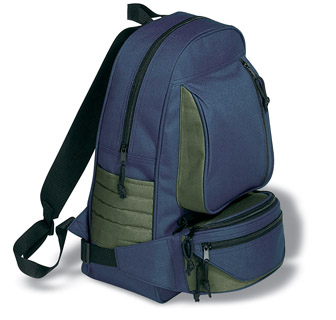

The 0/1 Knapsack problem is the most basic form and it can be easily solved using Dynamic Programming, currently known the best solution to this type of problem.
The problem can be described as: Given n items with values 


Mathematically this can be represented by the following optimization problem:
Maximize 




The values and weights are all assumed non-negative.
Using Dynamic Programming, the above problem can be solved using the following recursive expressions.
Assume f(i, w) represents the maximum values of choosing the first i items that do not exceed the total weight w.
The recursive formula is 

At the point of item i, we have two options, either choosing it or not choosing it. The answer is the maximum of the two decisions. By not choosing it, we have the answer of 


By this method, the problem is divided into the problems of smaller sizes. We can easily implement this by recursive functions.
It is obvious that we can not choose item i, if the current item exceeds the weight limit, the answer is 


If the requirement to pack the knapsack is to perfectly fill the knapsack, i.e. the total weights of all items put into the knapsack is equal to the maximum capacity, we should initialize 


The other possible case is that not all the knapsacks’ capacity is used, i.e. there is room possibly. In this case, we initialize all elements of 

Knapsack Problems
- Teaching Kids Programming - 0/1 Knapsack: Length of the Longest Subsequence That Sums to Target (Recursion+Memoization=Top Down Dynamic Programming)
- Teaching Kids Programming - 0/1 Knapsack Space Optimised Dynamic Programming Algorithm
- Teaching Kids Programming - Using Bottom Up Dynamic Programming Algorithm to Solve 0/1 Knapsack Problem
- Teaching Kids Programming - 0/1 Knapsack Problem via Top Down Dynamic Programming Algorithm
- Teaching Kids Programming - Multiple Strange Coin Flips/Toss Bottom Up Dynamic Programming Algorithm (Knapsack Variant)
- Teaching Kids Programming - Multiple Strange Coin Flips/Toss Top Down Dynamic Programming Algorithm (Knapsack Variant)
- Teaching Kids Programming - Max Profit of Rod Cutting (Unbounded Knapsack) via Bottom Up Dynamic Programming Algorithm
- Teaching Kids Programming - Max Profit of Rod Cutting (Unbounded Knapsack) via Top Down Dynamic Programming Algorithm
- Teaching Kids Programming - Brick Layout (Unlimited Knapsack) via Bottom Up Dynamic Programming Algorithm
- Teaching Kids Programming - Brick Layout (Unlimited Knapsack) via Top Down Dynamic Programming Algorithm
- Count Multiset Sum (Knapsacks) by Dynamic Programming Algorithm
- Count Multiset Sum (Knapsacks) by Recursive BackTracking Algorithm
- Dynamic Programming Algorithm to Solve the Poly Knapsack (Ubounded) Problem
- Dynamic Programming Algorithm to Solve 0-1 Knapsack Problem
- Classic Unlimited Knapsack Problem Variant: Coin Change via Dynamic Programming and Depth First Search Algorithm
- Classic Knapsack Problem Variant: Coin Change via Dynamic Programming and Breadth First Search Algorithm
- Complete Knapsack Problem
- 0/1 Knapsack Problem
- Teaching Kids Programming - Combination Sum Up to Target (Unique Numbers) by Dynamic Programming Algorithms
- Algorithms Series: 0/1 BackPack - Dynamic Programming and BackTracking
- Using BackTracking Algorithm to Find the Combination Integer Sum
- Facing Heads Probabilties of Tossing Strange Coins using Dynamic Programming Algorithm
- Partition Equal Subset Sum Algorithms using DFS, Top-Down and Bottom-up DP
–EOF (The Ultimate Computing & Technology Blog) —
Last Post: Codeforces: B. Spreadsheets
Next Post: Optimal SizeOf Code Generated in Delphi 2007