Given the head of a linked list and two integers m and n. Traverse the linked list and remove some nodes in the following way:
Start with the head as the current node.
Keep the first m nodes starting with the current node.
Remove the next n nodes
Keep repeating steps 2 and 3 until you reach the end of the list.
Return the head of the modified list after removing the mentioned nodes.Follow up question: How can you solve this problem by modifying the list in-place?
delete-n-nodes-after-m-nodes-of-a-linked-list
Example 1:
Input: head = [1,2,3,4,5,6,7,8,9,10,11,12,13], m = 2, n = 3
Output: [1,2,6,7,11,12]
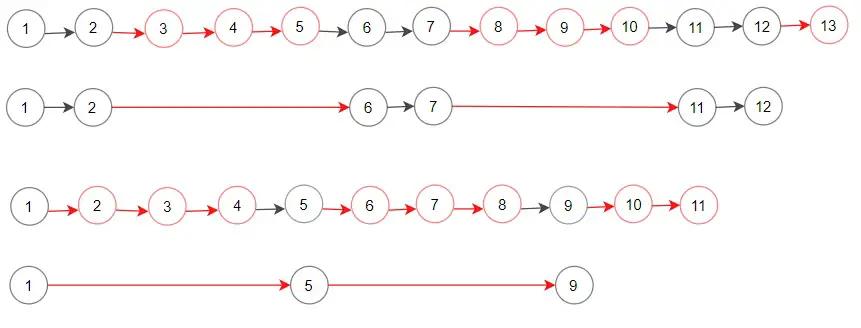
Explanation: Keep the first (m = 2) nodes starting from the head of the linked List (1 ->2) show in black nodes.
Delete the next (n = 3) nodes (3 -> 4 -> 5) show in read nodes.
Continue with the same procedure until reaching the tail of the Linked List.
Head of linked list after removing nodes is returned.Example 2:
Input: head = [1,2,3,4,5,6,7,8,9,10,11], m = 1, n = 3
Output: [1,5,9]
Explanation: Head of linked list after removing nodes is returned.Example 3:
Input: head = [1,2,3,4,5,6,7,8,9,10,11], m = 3, n = 1
Output: [1,2,3,5,6,7,9,10,11]Example 4:
Input: head = [9,3,7,7,9,10,8,2], m = 1, n = 2
Output: [9,7,8]Constraints:
The given linked list will contain between 1 and 10^4 nodes.
The value of each node in the linked list will be in the range [1, 10^6].
1 <= m,n <= 1000Hints:
Traverse the Linked List, each time you need to delete the next n nodes connect the nodes previous deleting with the next node after deleting.
C++ Algorithm to Delete N Nodes After M Nodes of a Linked List in Place
Most linked list problems can be helped by using a dummy header pointer. In this particular problem, we need also a previous pointer. By skipping current M nodes, and we need to link the previous pointer to next pointer – which basically delete N nodes.
/**
 * Definition for singly-linked list.
 * struct ListNode {
 *     int val;
 *     ListNode *next;
 *     ListNode() : val(0), next(nullptr) {}
 *     ListNode(int x) : val(x), next(nullptr) {}
 *     ListNode(int x, ListNode *next) : val(x), next(next) {}
 * };
 */
class Solution {
public:
    ListNode* deleteNodes(ListNode* head, int m, int n) {
        ListNode* dummy = new ListNode(-1);
        ListNode* prev = dummy;
        prev->next = head;
        while (head != NULL) {
            for (int i = 0; (i < m) && (head != NULL); ++ i) {
                prev = head;
                head = head->next;
            }
            for (int i = 0; (i < n) && (head != NULL); ++ i) {
                head = head->next;
            }
            prev->next = head;
        }
        return dummy->next;
    }
};
We also need to take care of the cases when there are less than M nodes to skip. In this case, we would just point previous pointer to NULL.
–EOF (The Ultimate Computing & Technology Blog) —
Last Post: Bruteforce Algorithm to Find the Unique Positive Integer Whose Square has the form 1_2_3_4_5_6_7_8_9_0 (Concealed Square)
Next Post: Dynamic Programming Algorithm to Compute the Max Dot Product of Two Subsequences