In [here], the basic 0/1 knapsack is discussed. For each item, you can choose to put or not to put into the knapsack. Therefore, for the number of items, there are only two options: 0 or 1.
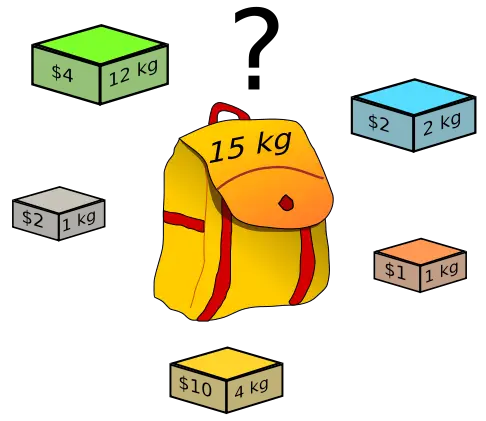
In Complete Knapsack Problem, for each item, you can put as many times as you want. Therefore, if capacity allows, you can put 0, 1, 2,  items for each type. The Complete Knapsack Problem can also be modelling using 0/1 Knapsack.
>

Similar to 0/1 Knapsack, there are O(WN) states that need to be computed. However, for the 0/1 knapsack, the complexity of solving each state is constant. The Complete Knapsack needs  for each state. The total complexity can be considered as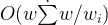
One greedy optimisation is to replace items of heavier-but-less-valuable items with ones of lighter-more-valuable. If  and
and  we can simply and safely use item j instead of item i. This optimisation process can be done in
  time.
time.
Another straightforward transform to 0/1 Knapsack Problem is to consider the maximum number of times for item i to put is  . Therefore, we can treat item i as [/math] w / w_i [/math] items that are of same weight w_i. This does not increase time complexity: by simply splitting one item into many.
The other better transform is to split item i to items that have weights  and values
  for
for  . This is based on binary. No matter how many items we choose, we can represent the total number as the sum of many
  sub-items. This splitting yields
  .
.
Knapsack Problems
- Teaching Kids Programming - 0/1 Knapsack: Length of the Longest Subsequence That Sums to Target (Recursion+Memoization=Top Down Dynamic Programming)
- Teaching Kids Programming - 0/1 Knapsack Space Optimised Dynamic Programming Algorithm
- Teaching Kids Programming - Using Bottom Up Dynamic Programming Algorithm to Solve 0/1 Knapsack Problem
- Teaching Kids Programming - 0/1 Knapsack Problem via Top Down Dynamic Programming Algorithm
- Teaching Kids Programming - Multiple Strange Coin Flips/Toss Bottom Up Dynamic Programming Algorithm (Knapsack Variant)
- Teaching Kids Programming - Multiple Strange Coin Flips/Toss Top Down Dynamic Programming Algorithm (Knapsack Variant)
- Teaching Kids Programming - Max Profit of Rod Cutting (Unbounded Knapsack) via Bottom Up Dynamic Programming Algorithm
- Teaching Kids Programming - Max Profit of Rod Cutting (Unbounded Knapsack) via Top Down Dynamic Programming Algorithm
- Teaching Kids Programming - Brick Layout (Unlimited Knapsack) via Bottom Up Dynamic Programming Algorithm
- Teaching Kids Programming - Brick Layout (Unlimited Knapsack) via Top Down Dynamic Programming Algorithm
- Count Multiset Sum (Knapsacks) by Dynamic Programming Algorithm
- Count Multiset Sum (Knapsacks) by Recursive BackTracking Algorithm
- Dynamic Programming Algorithm to Solve the Poly Knapsack (Ubounded) Problem
- Dynamic Programming Algorithm to Solve 0-1 Knapsack Problem
- Classic Unlimited Knapsack Problem Variant: Coin Change via Dynamic Programming and Depth First Search Algorithm
- Classic Knapsack Problem Variant: Coin Change via Dynamic Programming and Breadth First Search Algorithm
- Complete Knapsack Problem
- 0/1 Knapsack Problem
- Teaching Kids Programming - Combination Sum Up to Target (Unique Numbers) by Dynamic Programming Algorithms
- Algorithms Series: 0/1 BackPack - Dynamic Programming and BackTracking
- Using BackTracking Algorithm to Find the Combination Integer Sum
- Facing Heads Probabilties of Tossing Strange Coins using Dynamic Programming Algorithm
- Partition Equal Subset Sum Algorithms using DFS, Top-Down and Bottom-up DP
–EOF (The Ultimate Computing & Technology Blog) —
813 wordsLast Post: How Programmer Reads Your CV?
Next Post: The Simple Tutorial to Disjoint Set (Union Find Algorithm)