
Teaching Kids Programming: Videos on Data Structures and Algorithms

Let’s take a look at this golden ratio continued fraction:
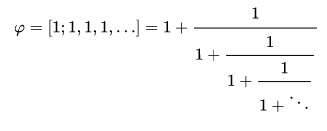
continued-fraction-golden-ratio
We can see the pattern is recursive (infinitely) and thus we can replace portion of the expression with itself:
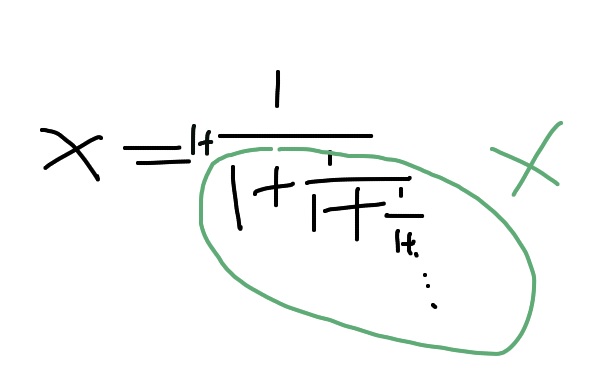
continued-fraction-math


Thus:


So we have a positive root:


Similarly, if the continued fraction is [2:2,2,2,2,2….], the value is 

We can use the values from both to estimate the value of 


We can implement the continued fraction using the following Python code (Recursive manner). The parameter n is the number of the iterations to go. Beware that when n is large, the Recursion may be causing stack-over-flow if compiler hasn’t been able to tail optimise it.
def continuedFraction(n, a):
    if n == 0:
        return a / (a + a/a)
    return a / (a + continuedFraction(n - 1, a))
We can also do this iteratively (and in practice more efficient than the Recursive version):
def continuedFraction(n, a):
    ans = 0
    for _ in range(n):
        ans = a / (a + ans)
    return ans
–EOF (The Ultimate Computing & Technology Blog) —
Last Post: Teaching Kids Programming - Top Down and Bottom Up Recursive Algorithms to Determine a Balanced Binary Tree
Next Post: Teaching Kids Programming - Clone (Deep Copy) a Undirected Connected Graph using Recursive Depth First Search Algorithm