In [here], the algorithm is introduced that counts the average number of addition for sum to reach one, which approximates the math constant  . The following will count the probability using an array (e.g. similar to buckets).
#!/usr/bin/env python

from random import seed, random

cnt = [0] * 20

def count():
    global cnt
    x = 0
    s = 0
    while True:
        s += random()
        x += 1
        if s >= 1:
            break
    cnt[x] += 1

for x in range(0, 100000):
    count()

for x in cnt:
    print x
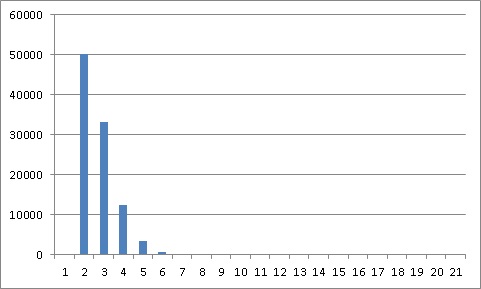
As expected, after quite a long term iteration, the appearance of answer two (two numbers adds to a number larger than one) is dominanting.
0
0
50106
33285
12402
3412
667
109
18
1
0
0
0
0
0
0
0
0
0
0
The plot is here.
See also: Simple and Efficient C Program to Compute the Mathematic Constant E (Euler’s number)
–EOF (The Ultimate Computing & Technology Blog) —
237 wordsLast Post: Boy or Girl? Python Validation
Next Post: How Many Zeros at the end of 1024!?